The first quarter of 2026 will be remembered as one of the most geopolitically intense periods of recent years. From Venezuela’s rapid political decapitation to a hot war in the Middle East, global markets faced an unpleasant combination of geo-political uncertainty and major price shocks. Yet, despite the noise, diversified portfolios once again demonstrated their resilience - a timely reminder that, unless one somehow has advance knowledge of what President Trump will do next (which we often doubt even the man himself possesses), timing the market successfully always requires more luck than judgement. Diversification and a long‑term perspective remain the most reliable foundations for compounding wealth.
Geopolitical Backdrop: Venezuela and the Middle East
Venezuela’s crisis deepened throughout Q1, with further disruptions to energy infrastructure and exports adding to global supply concerns. This was exacerbated when tensions between the U.S., Israel and Iran escalated sharply. After US and Israeli strikes “took out” a significant number of high-ranking Iranian officials (including the Ayatollah himself) Iranian drone strikes on Kuwait, the UAE and Saudi and Qatari energy facilities contributed to fears of broader regional destabilisation.
Brent crude oil surged over 30% in March alone (at one point hitting as much $120 a barrel) as oil and gas tankers avoided the Strait of Hormuz, which has been effectively closed to commercial traffic since early March.
Although President Trump has signalled that U.S. forces could withdraw from Iran within weeks, global tensions look unlikely to dissipate any time soon. Some observers fear that Cuba could become the next focal point of Trump’s expanding “maximum pressure” strategy, especially given the increasingly confrontational rhetoric coming from Washington.
Commodity Markets React Strongly
As you would expect, commodity markets reacted strongly to the geopolitical turbulence and shifting growth expectations. Gold and silver, despite traditionally acting as safe-haven assets, experienced sharp monthly declines as investors rotated toward the U.S. dollar amid expectations of more restrictive monetary policy.
Industrial metals were not spared either. Copper prices fell over 6% across the month as Middle East tensions pushed up energy costs - a core input to copper production - as investors grew anxious about slowing global manufacturing activity.
Energy markets moved in the opposite direction. Brent crude oil’s sharp monthly rise of nearly 32% was a direct response to supply disruptions and geopolitical uncertainty. European natural gas prices also increased by around 9% over the month as markets priced in risks to LNG flows and potential future supply shortages.
| Commodity | 1-Month Change | 12-Month Change |
| Gold | -13.81% | +47.26% |
| Silver | -16.45% | +120.83% |
| Copper | -6.31% | +9.91% |
| Brent Crude Oil | +31.95% | +36.87% |
| EU Natural Gas (TTF) | +8.98% | +18.31% |
Edgewater Portfolio Performance
While we illustrate performance using four of our model portfolios, the figures set out below are only representative. In practice, every client’s portfolio is individually constructed to reflect their circumstances, objectives and capacity for risk.
Despite the turbulence, diversified multi-asset portfolios absorbed Q1 volatility in a predictable manner: short-term drawdowns, followed by stabilisation, with long-term returns remaining firmly positive.
5-Year Performance
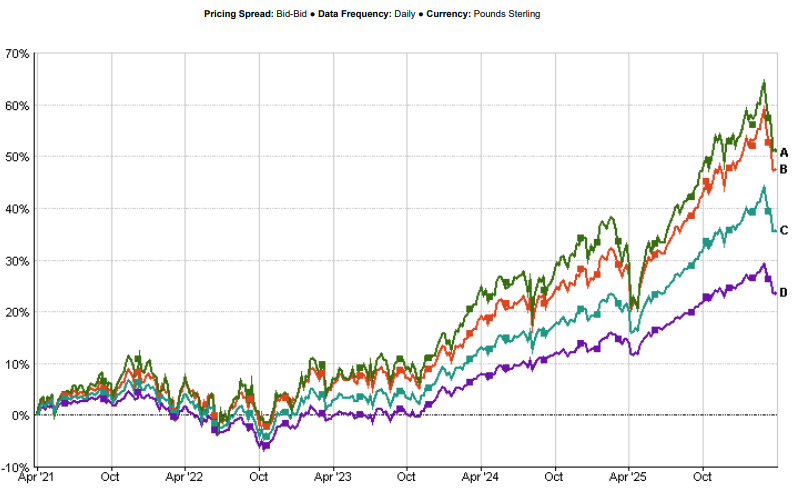
| Portfolio | Risk Profile | 3-Month Return | 12-Month Return | 5-Year Return |
| Portfolio (A) | 5 | -0.93% | 17.91% | 50.91% |
| Portfolio (B) | 4 | -1.13% | 17.50% | 47.80% |
| Portfolio (C) | 3 | 1.14% | 13.83% | 35.86% |
| Portfolio (D) | 2 | -2.15% | 9.15% | 23.96% |
The long-term results are clear: short-term volatility does not erase long-term compounding. Even with energy shocks, geopolitical crises, inflation scares and shifting central bank guidance, well-diversified portfolios continue to produce strong multi-year returns.
Why Long-Term Investors Should Stay the Course
Q1 2026 provided a masterclass in why trying to time the market or being too cute with your investment decisions can lose you money. Markets moved sharply, unpredictably, and often contrary to expectations. Few would have forecast that gold - typically the archetypal safe-haven asset - would see one of its steepest monthly drops in nearly two decades at the same time as Middle East hostilities intensified. Fewer still could reliably anticipate how President Trump’s shifting geopolitical messaging would influence investor sentiment. Remember:
- Short-term outcomes are driven by headlines, emotion and positioning.
- Long-term outcomes are driven by earnings growth, innovation, demographics, debt dynamics, and productivity.
The latter always dominates over time.
This is why maintaining discipline, staying invested and following a structured financial plan remains the most effective and evidence-based way to achieve long-term financial success. We went into more depth on this topic in our previous article Market Turbulence: Why Long-Term Investors Should Stay the Course.
If you have any questions, concerns, or would like to discuss how these themes may affect your investment portfolio, please don’t hesitate to contact us. We would be very happy to help you navigate the opportunities and risks ahead.
This article reflects our own interpretation and expectations regarding global macroeconomic and geopolitical developments. It is intended solely for general information and discussion purposes and should not be regarded as financial, legal, or professional advice.
Market Insights
Our Investment Committee regularly publishes market updates, financial commentary, and insights on Government policy changes that you may find useful. These can be found on our website, as well as Edgewater LinkedIn and Edgewater Facebook pages. Please like and follow our channels to ensure you don’t miss out.