Periods of heightened geopolitical tension - such as the events over the weekend involving the U.S., Iran and regional actors - often dominate headlines and understandably lead to concerns among investors.
However, market participants should always remember that turbulence is a feature of global markets, not a bug, and that volatility is a normal and expected part of investing. Over the course of any given year, markets can experience sharp movements driven by political events, economic data, corporate announcements, or sudden changes in sentiment. While these episodes can feel unsettling in the moment, they rarely alter the long-term trajectory of well-constructed portfolios.
Your Portfolio Is Built Around You
At Edgewater, our investment philosophy begins with understanding each client's individual circumstances. Before any capital is invested, we work closely with you to establish an appropriate risk profile, taking into account your risk tolerance, time horizon, and capacity for loss. This ensures your portfolio is aligned with your personal financial goals and your comfort with market fluctuations.
This foundation is critical, because a portfolio built around your own risk parameters is designed not only to capture long-term growth, but also to navigate episodes of volatility without requiring reactive changes.
Why Timing the Market Doesn't Work
When news headlines turn negative, it can be tempting to move into cash, or to move into lower risk assets "until things calm down." However, history shows that timing the market is extraordinarily difficult - even for seasoned professionals. Markets tend to fall quickly and recover just as quickly, often without warning.
One of the most powerful investment lessons comes from a study by J.P. Morgan that showed between 2003 and 2023, an investor who stayed fully invested in the S&P 500 earned an annualised return of around 9.8%. However, missing just the 10 best days in that entire 20-year period cut the return nearly in half, down to 5.6%. Missing the 20 best days reduced it to 2.9%, and missing the 30 best days brought long-term performance close to zero.
What makes this even more striking is that many of the best days tend to occur immediately after the worst days, often during periods of extreme market stress. This highlights why staying invested is typically far more beneficial than attempting to predict turning points.
Time in the Market Matters Most
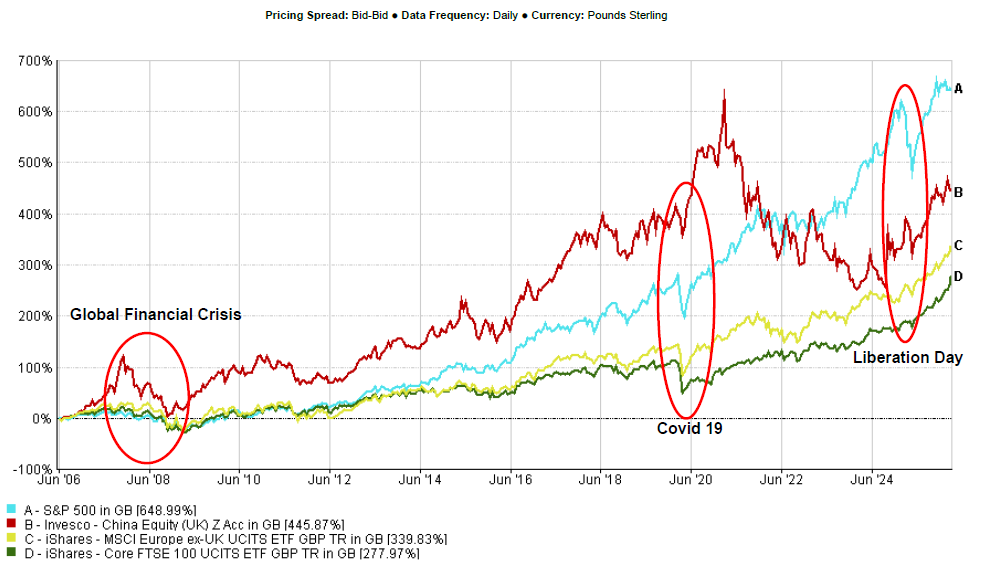
The chart above shows the major global equity indices (US, China, Europe and UK) going back to 2007. This long-term perspective illustrates an important truth: even major global shocks eventually become small blips on a long-run chart. Investors who stayed the course throughout these periods were consistently rewarded.
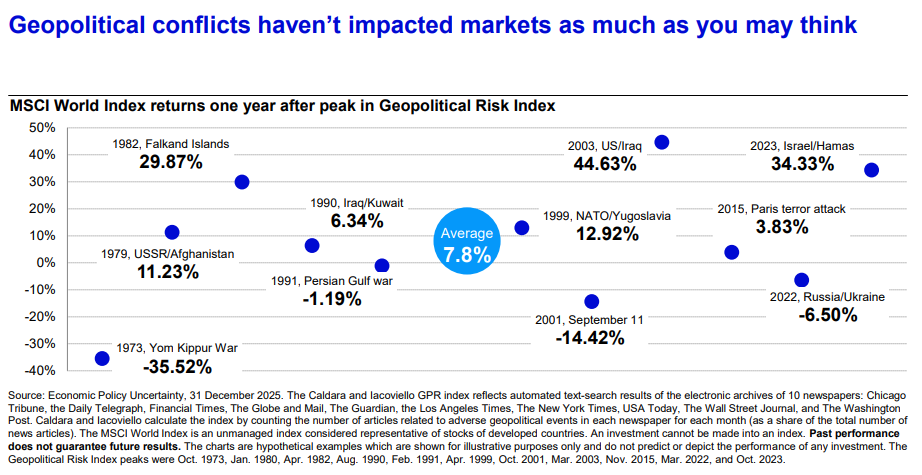
And as the graphic below from Invesco illustrates, markets ultimately tend to look through geo-political turmoil, with equities often finishing higher just 12-months after major geo-political tensions.
Diversification: Your First Line of Defence
Another cornerstone of our approach at Edgewater is diversification. We build portfolios that spread exposure across:
- Multiple asset classes
- Global regions
- Market sectors
- Investment styles and themes
Diversification doesn't eliminate short-term declines, but it does reduce the impact of any single event or region on your overall performance. When one part of the market experiences stress, others may be more resilient or even benefit from changing conditions.
This balanced approach helps cushion portfolios during market shocks and positions clients to participate in recoveries whenever and wherever they occur.
Our Commitment to You
We want to reassure all clients that we monitor global events closely and continually assess portfolio positioning. If conditions change in a way that warrants strategic adjustments, we will communicate this proactively.
In the meantime, the core principles of successful investing remain unchanged:
- Stay diversified
- Avoid emotional decision-making
- Maintain a long-term perspective
- Trust the process we have built together
If you have any questions or wish to discuss your portfolio, our team is always available to help you navigate periods of uncertainty with confidence.
This article reflects our own interpretation and expectations regarding global macroeconomic and geopolitical developments. It is intended solely for general information and discussion purposes and should not be regarded as financial, legal, or professional advice.
Keep yourself updated!
Our Investment Committee regularly publishes market updates, financial commentary, and insights on Government policy changes that you may find useful. These can be found on our website, as well as our LinkedIn and Facebook pages. Please like and follow our channels to ensure you don't miss out.
LinkedIn
FaceBook