The third quarter began with reasons for cautious optimism — economic growth in the UK and elsewhere holding up better than expected. However, as the quarter progressed, renewed geopolitical tensions pushed oil and gas prices higher, government bond yields rose, and central banks became more cautious about the outlook for inflation.
The result was stronger than expected growth, mounting inflation risks and elevated borrowing costs. For investors, Q3 provided another reminder that economies and financial markets do not always move together. Stronger economic data can support company earnings, but it can also delay interest-rate cuts and push bond yields higher. In this environment, diversification and a long-term perspective remained as important as ever.
Geopolitics returned to the centre of markets
Geopolitical developments continued to dominate headlines throughout the quarter. The conflict involving the United States and Iran remained the greatest immediate risk to global energy markets. Periods of heightened military activity and renewed concerns over shipping through the Strait of Hormuz and the Red Sea contributed to sharp movements in oil and natural gas prices.
The war between Russia and Ukraine also intensified beyond the conventional front line. Ukraine increased long-range attacks on Russian energy infrastructure, while Russia launched further missile and drone strikes against Ukrainian cities and power networks.
These events did not prevent markets from making progress, but they did increase volatility and contributed to renewed pressure on energy prices, inflation expectations and government bond yields.
Energy prices changed the direction of the quarter
At the start of Q3, the economic narrative was relatively encouraging and underlying inflation appeared contained. This supported the view that central banks might gradually be able to reduce interest rates and stimulate economies further.
By September, however, oil and European natural gas prices rose materially as markets digested the continued disruption to Middle Eastern production and shipping, and the targeting of Russian oil refineries. Higher energy prices affected the economic outlook through a number of channels:
- Petrol, transport and household energy costs placed upward pressure on headline inflation.
- Businesses faced higher manufacturing, distribution and travel costs.
- Household disposable incomes came under renewed pressure.
- Central banks had less room to reduce interest rates.
- Government borrowing costs and debt-interest expenditure increased.
- Companies unable to pass on higher costs were faced with pressure on profit margins.
Commodity performance
| Commodity | Benchmark | 30 Sept 2026 price |
|---|---|---|
| Gold | COMEX active futures | $4,186.70 per oz |
| Silver | COMEX active futures | $60.720 per oz |
| Copper | COMEX active futures | $6.6293 per lb |
| Brent crude | ICE front-month futures | $103.53 per barrel |
| European natural gas | Dutch TTF front-month futures | ~€72.36 per MWh |
Gold and silver continued to attract demand amid geopolitical uncertainty, while copper benefited from strategic infrastructure investment and long-term demand linked to electrification, data centres and power networks. Brent crude oil and European natural gas were more directly affected by developments in the Middle East and Russia..png)
Diesel prices also became an unexpected talking point during the quarter, with prices in the Isle of Man rising to £1.90 per litre, and over £2 per litre in the UK for the first time. The UK consumes almost twice as much diesel as petrol, yet refineries typically produce nearly twice as much petrol as diesel. This challenge has been compounded by the long-term decline of the UK's refining sector. The UK had 18 operational oil refineries during the 1970s, but now has just four remaining following the closures of Grangemouth and Lindsey in 2025. As a result, the UK has become increasingly reliant on imported fuels to meet domestic demand.
The global economy remained surprisingly resilient
Despite geopolitical and inflationary pressures, the global economy performed better than many forecasters had anticipated. Business activity remained broadly positive in the United States, the UK and parts of Europe.
Large technology businesses are committing significant capital to computing capacity, energy networks and related infrastructure. AI is therefore no longer simply an equity-market theme. It is influencing investment, demand for electricity, corporate borrowing and long-term interest rates across the wider economy.
AI-related investment could usher in a wave of increased productivity, support future economic growth and create demand across a wide range of industries. But the scale of investment also presents risks.
For now, many of the leading technology companies remain highly profitable and continue to generate substantial cash flows. This is an important distinction from the dot-com era, when many businesses achieved extreme valuations despite having limited revenue and no profits. Nevertheless, strong underlying businesses can still become expensive investments. Careful diversification remains essential.
UK growth exceeded expectations
In the UK specifically, economic output in July increased by 0.4% month on month, exceeding expectations for little or no growth. Services remained the main driver, with strong activity in information and communication, software, professional services and administrative support.
That said, the recovery was not universal, with areas such as transportation, household products, metals and some professional services remaining weaker.
This resilience reduced the immediate risk of recession, but it also made the outlook for interest rates more complicated. Stronger activity gave the Bank of England less reason to cut rates, particularly as rising energy prices have already pushed headline inflation higher.
Inflation rose — but its composition matters
UK consumer price inflation increased to 3.1% in August. The increase was largely associated with fuel, transport and energy costs. Core inflation — which removes some of the more volatile components — remained better contained, while services inflation and private-sector wage growth provided limited evidence of renewed domestic overheating.
The rise in inflation was principally external and energy-driven. However, the longer higher prices persist, the greater the risk that so-called "second round effects" could begin to drive things like wage negotiations and household inflation expectations, pushing domestic inflation higher.
At its September meeting, the Bank of England kept Bank Rate at 3.75%, with six members voting to leave rates unchanged and three voting to increase the rate to 4%.
Higher gilt yields, mortgage rates and corporate borrowing costs have already been restraining demand, meaning that financial markets have already been doing some of the work that might otherwise have required an increase in Bank Rate. For households and businesses, the practical implication was that borrowing costs were likely to remain higher for longer than many had expected at the beginning of the year.
Bond markets experienced a major repricing
Government bond yields rose sharply during Q3 as investors responded to resilient growth, higher energy prices, increased government borrowing and the prospect of interest rates remaining elevated. In the UK, gilt yields reached levels not seen since the 1990s.
| Maturity | 31 July | 31 August | 30 Sept | Q3 movement |
|---|---|---|---|---|
| 2-year gilt | 4.32% | 4.38% | 4.90% | +58 bps |
| 10-year gilt | 4.95% | 5.14% | 5.44% | +49 bps |
| 30-year gilt | 5.79% | 5.77% | 5.95% | +17 bps |
- For the Government, higher yields increase the cost of servicing public debt and reduced the Chancellor's room for manoeuvre ahead of the Autumn Budget.
- For households, mortgage and refinancing costs remained elevated.
- For businesses, more expensive borrowing discourages investment.
- For equity investors, higher bond yields create a more demanding valuation environment as shares needed to compete with the higher yields available in bond markets.
- For bond investors, higher yields cause volatility in the capital value of bonds, but they also created more attractive income opportunities for new investment.
The UK's public finances attracted closer attention
The combination of higher gilt yields and higher than predicted government borrowing made the UK fiscal position more difficult. The concern is not necessarily that the Government faces an immediate funding crisis, but that higher debt-interest costs reduce the amount of money available for public services, investment, or tax reductions. Many are now pencilling in another round of tax rises in the UK budget at the end of this month.
Here in the Isle of Man, movements in UK interest rates, sterling and gilt markets remain particularly relevant because of the close economic and financial links between us and the UK. This is particularly true in respect of Manx inflation and mortgage rates.
Equity markets remained resilient
Despite higher bond yields and geopolitical uncertainty, global equity markets remained resilient — although market leadership remained concentrated in a relatively small number of large companies. This concentration is not necessarily evidence that a market decline is imminent, but it does create vulnerability. When a small group of companies accounts for a large proportion of index returns, disappointment from even one or two leading businesses can have a disproportionate effect on the wider market. This is another reason why a diversified portfolio is key to long-term investing.
Edgewater Portfolio Performance
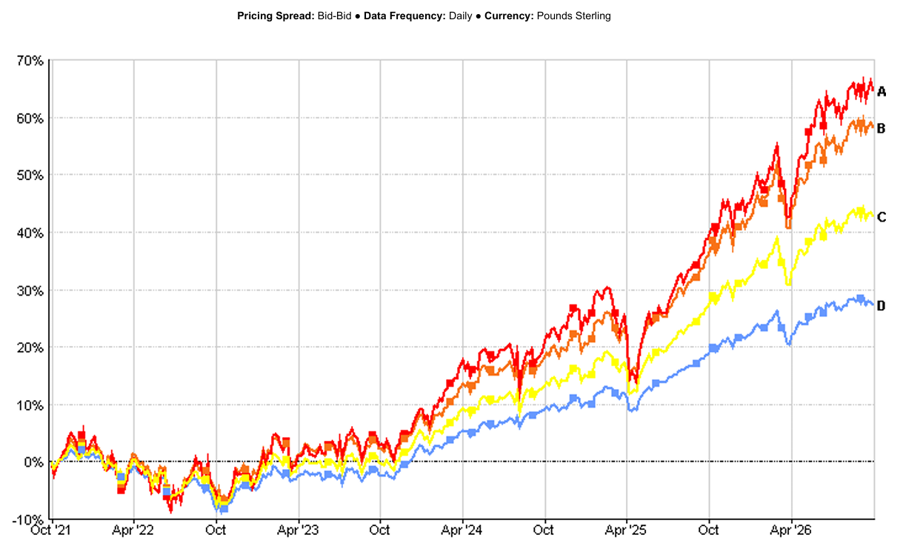
While we illustrate performance using four of our model portfolios, the figures set out below are only representative. In practice, every client's portfolio is individually constructed to reflect their circumstances, objectives and capacity for risk.
| Portfolio | Risk Profile | 3-Month Return | 12-Month Return | 3-Year Return | 5-Year Return |
|---|---|---|---|---|---|
| Portfolio (A) | 5 | 0.86% | 18.37% | 59.35% | 64.69% |
| Portfolio (B) | 4 | 1.22% | 16.44% | 53.85% | 58.26% |
| Portfolio (C) | 3 | 0.56% | 12.37% | 42.42% | 42.81% |
| Portfolio (D) | 2 | -0.26% | 7.28% | 29.91% | 27.42% |
* Figures correct as at close of business 06/10/2026
Portfolio outcomes should always be considered in the context of each client's objectives, time horizon and capacity for risk. Periods of geopolitical uncertainty and changing interest-rate expectations are uncomfortable, but they are also a normal feature of long-term investing. Investors who react to short-term headlines risk selling after markets have already fallen and returning only after prices have recovered.
Diversified portfolios are not designed to avoid every decline. They are designed to provide exposure to different sources of return and reduce dependence on any single market outcome. Different parts of a portfolio respond differently to different market events. Maintaining a balanced allocation helps reduce the need to predict which individual scenario will occur next.
Always remember that the value of investments can fall as well as rise and you may get back less than you invest.
Looking ahead
The final quarter of 2026 is unlikely to be free from uncertainty. Energy prices and developments in the Middle East will remain important. The war in Ukraine continues, relations between the United States and China remain tough, and significant questions surround the direction of UK fiscal policy.
Markets will also be watching for evidence that higher energy prices are affecting wages and services inflation. If the inflation shock remains largely confined to energy and transport, central banks may retain scope to reduce rates once pressures subside. If it becomes more broadly embedded, borrowing costs could remain elevated for longer.
Staying focused on the long term
Our core investment philosophy remains unchanged. Financial markets will continue to respond to wars, elections, inflation data, interest-rate decisions and changing investor sentiment. Some developments will have lasting economic consequences, while others will create only temporary volatility. It is rarely possible to distinguish between the two in real time.
For that reason, successful investing should not depend on predicting the next geopolitical development or central-bank decision. It should be based on a clear understanding of your objectives, an appropriate level of risk and a diversified portfolio capable of navigating a range of possible outcomes.
If you have any questions, concerns, or would like to discuss how these themes may affect your investment portfolio, please don't hesitate to contact our team. We would be very happy to help you navigate the opportunities and risks ahead.
Market Insights
Our Investment Committee regularly publishes market updates, financial commentary, insights on Government policy changes and relevant policy developments that we believe you will find useful. These can be found on Edgewater's website (under "Insights"), as well as Edgewater LinkedIn and Edgewater Facebook pages. Please be sure to like and follow our channels to ensure you don't miss out on any new publications.
This article is directed at residents of the Isle of Man only and is not an offer or solicitation in any other jurisdiction. This article reflects our own interpretation and expectations regarding global macroeconomic and geopolitical developments. This article is intended for general information and discussion only and should not be regarded as financial, legal or professional advice.